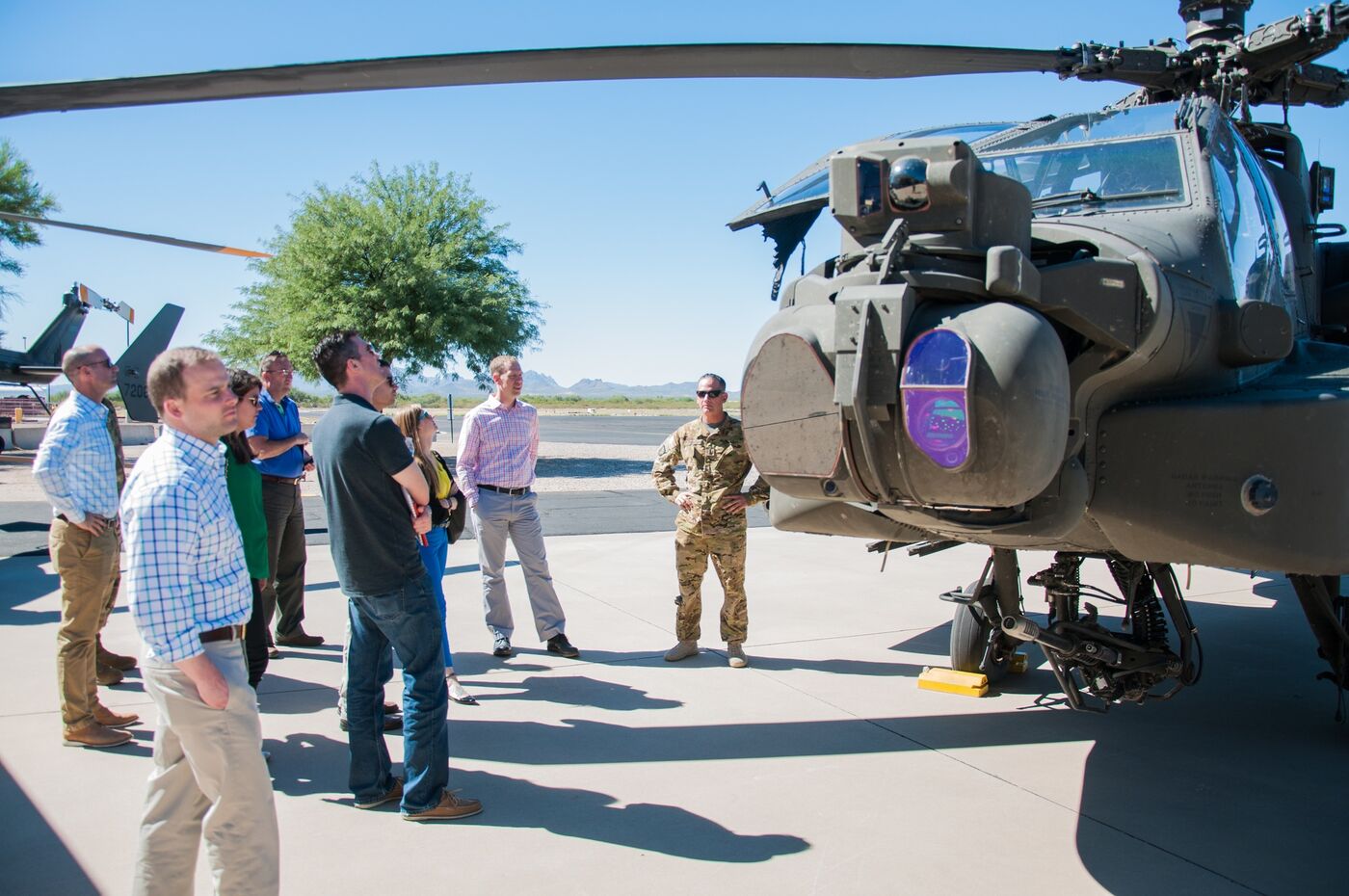
Silverbell Army Heliport
Silverbell Army Heliport is an Arizona Army National Guard aviation installation located near Marana, Arizona, in the Sonoran Desert about 30 miles northwest of Tucson and in the vicinity of Pinal Airpark. The heliport is home to the Western Army National Guard Aviation Training Site (WAATS), which was established in 1986 to provide advanced individual training for Army National Guard helicopter pilots and maintainers. The facility is recognized as a premier location for attack and aero-scout helicopter training, and it instructs personnel from the regular Army, the Army Reserve, and the Army National Guard, as well as allied nations. Units associated with the post have included the 1st Battalion, 285th Aviation Regiment of the Arizona Army National Guard. Over its decades of operation the site has trained thousands of aviators and support soldiers.
As with many military aviation facilities, concerns about potential exposure at Silverbell Army Heliport center on contaminants detected in or associated with the installation. Defense Department data obtained by the Environmental Working Group under the Freedom of Information Act documented per- and polyfluoroalkyl substances in the heliport's drinking water at 39.17 parts per trillion, with detections recorded between 2016 and 2018. According to that reporting, the result was the second-highest among Arizona's seven contaminated Army installations.
- PFAS (per- and polyfluoroalkyl substances) are a large family of synthetic chemicals valued for their resistance to heat, water, and oil. At facilities such as Silverbell Army Heliport, PFAS have most commonly been associated with firefighting foams used in aviation fire suppression and training. PFAS are persistent in the environment and the human body, and exposure to certain PFAS has been associated in some studies with a range of health concerns.
- PFOS (perfluorooctane sulfonate) is one of the specific PFAS compounds reported among the detections at the heliport. It was historically an ingredient in aqueous film-forming foam (AFFF) and in various consumer products. Research has examined possible associations between PFOS exposure and effects on the immune system, liver, and other outcomes, though findings continue to be studied.
- PFOA (perfluorooctanoic acid) is another PFAS compound identified in connection with the installation. PFOA was once widely used in manufacturing nonstick and stain-resistant coatings and could be present in legacy firefighting formulations. Exposure to PFOA has been the subject of ongoing study regarding potential health concerns.
Silverbell Army Heliport is not listed on the National Priorities List as a federal Superfund site. Investigation and response activities related to PFAS at the heliport fall under the broader Department of Defense and Army National Guard environmental programs, which have been assessing and addressing PFAS at installations nationwide. The Arizona Army National Guard has stated that drinking water it provides is intended to comply with Safe Drinking Water Act standards, and federal PFAS investigation and cleanup efforts at many sites have remained in earlier assessment phases.
Veterans, family members, and civilian workers who spent time at Silverbell Army Heliport may wish to stay informed as monitoring and federal PFAS programs continue to develop. Anyone with questions about possible exposure and related benefits is encouraged to speak with the U.S. Department of Veterans Affairs and a personal health care provider, who can offer guidance based on individual circumstances.
Were you stationed at a contaminated site?
The PACT Act of 2022 added more than 20 presumptive conditions for toxic exposure, including many cancers, and there is no deadline to file a VA claim.
This page is for informational purposes only and is not medical or legal advice. Consult a qualified professional about your health or benefits.
Discussion
No approved comments yet.