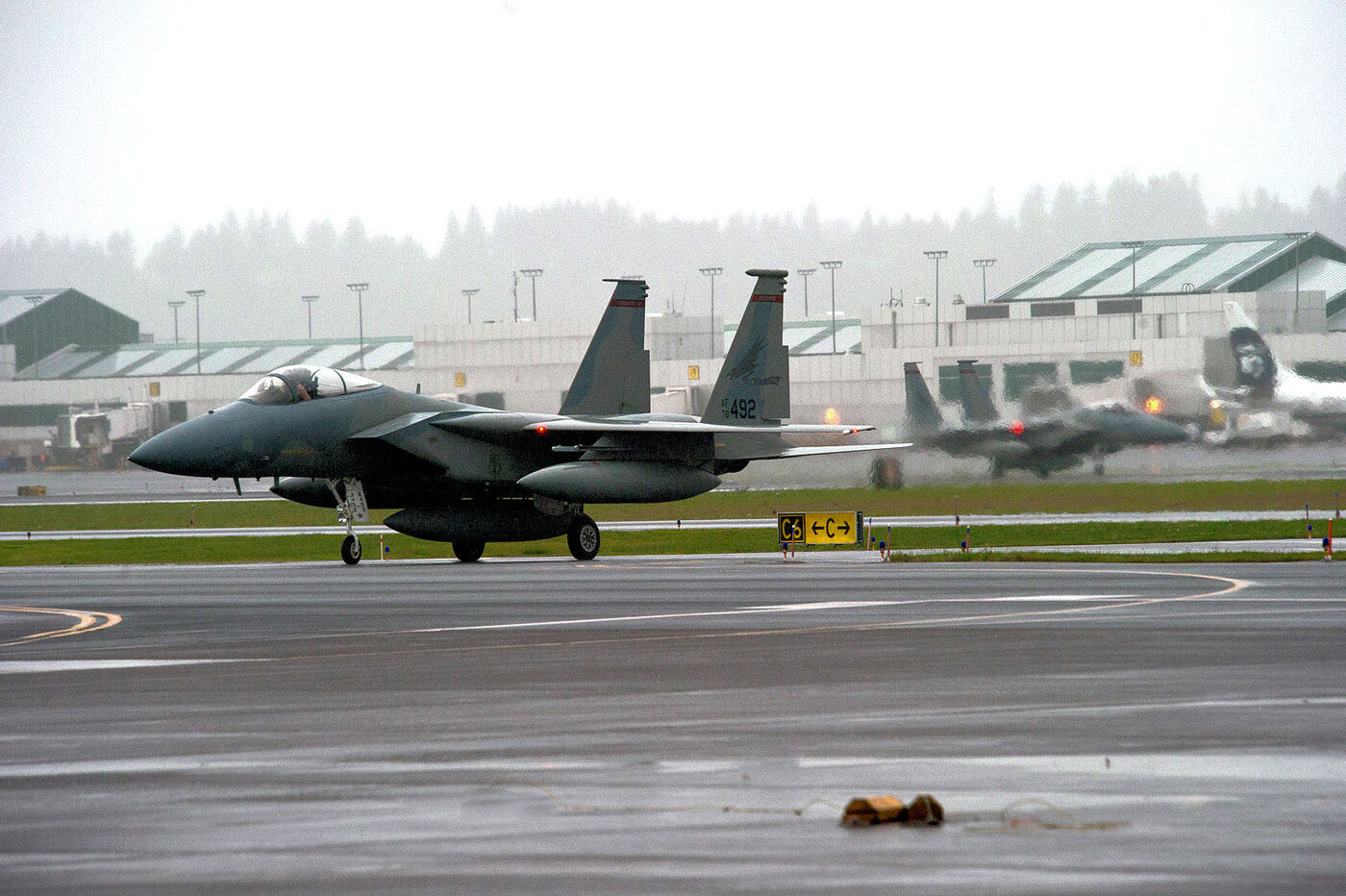
Portland Air National Guard Base
Portland Air National Guard Base is an Oregon Air National Guard installation located on the south side of Portland International Airport, bordering the Columbia Slough in Portland, Oregon. The site traces its origins to 1936, when the City of Portland acquired land along the Columbia River for what became a major airport, and the modern flying mission took shape after the 142nd Fighter Group was formed in 1946. The base is home to the 142nd Wing, which has flown the F-15 Eagle and serves as the principal aerospace control alert location for the Pacific Northwest under the North American Aerospace Defense Command. Over the decades, fire suppression training and aircraft alert operations supported the base's air defense role. As with many older military airfields, certain materials used in those activities have since drawn environmental scrutiny.
Concerns about potential exposure at Portland Air National Guard Base center on the long-term use of firefighting foam during live-fire training, which has been associated with the release of persistent chemicals into soil, groundwater, and nearby surface water.
- AFFF (aqueous film-forming foam): AFFF is a firefighting foam that was used at the base for live-fire training and aircraft fire suppression. Repeated use during training exercises is understood to be the primary pathway by which related chemicals entered the environment at this site, and exposure to its components has been associated with a range of health concerns under continued study.
- PFAS (per- and polyfluoroalkyl substances): PFAS are a large family of synthetic chemicals found in AFFF and valued for their resistance to heat and water. At Portland Air National Guard Base, investigations reported PFAS concentrations in surface water at roughly 1,500 parts per trillion and in groundwater exceeding 40,000 parts per trillion, with detections also noted in the adjacent Columbia Slough. PFAS are persistent in the environment and the body, and research has examined their potential links to several health conditions.
- PFOS (perfluorooctane sulfonate): PFOS is a specific PFAS compound that was a common ingredient in legacy firefighting foams used at installations like this one. Because it breaks down very slowly, PFOS has been a focus of testing in groundwater and surface water, and studies have explored concerns about potential effects from long-term exposure.
- PFOA (perfluorooctanoic acid): PFOA is another individual PFAS compound associated with older foam formulations and industrial uses. As part of the broader PFAS family detected at the base, PFOA has been included in environmental sampling, and ongoing research continues to examine the health questions surrounding exposure.
This base is not listed on the federal National Priorities List. Cleanup and investigation are proceeding under Oregon Department of Environmental Quality oversight, with the agency working under voluntary agreements involving the Port of Portland. According to reporting in 2025, the Department of Defense delayed the PFAS investigation and cleanup planning timeline for the Portland site from a previously expected completion around 2025 to roughly 2031, with officials citing a shift of resources toward other sites that had not yet been investigated.
Veterans, civilian employees, and family members who spent time at Portland Air National Guard Base may wish to stay informed as testing and cleanup efforts continue. Anyone with questions about possible exposure and related health concerns is encouraged to speak with the U.S. Department of Veterans Affairs and personal healthcare providers, who can offer guidance based on individual circumstances and the latest available information.
Were you stationed at a contaminated site?
The PACT Act of 2022 added more than 20 presumptive conditions for toxic exposure, including many cancers, and there is no deadline to file a VA claim.
This page is for informational purposes only and is not medical or legal advice. Consult a qualified professional about your health or benefits.
Discussion
No approved comments yet.