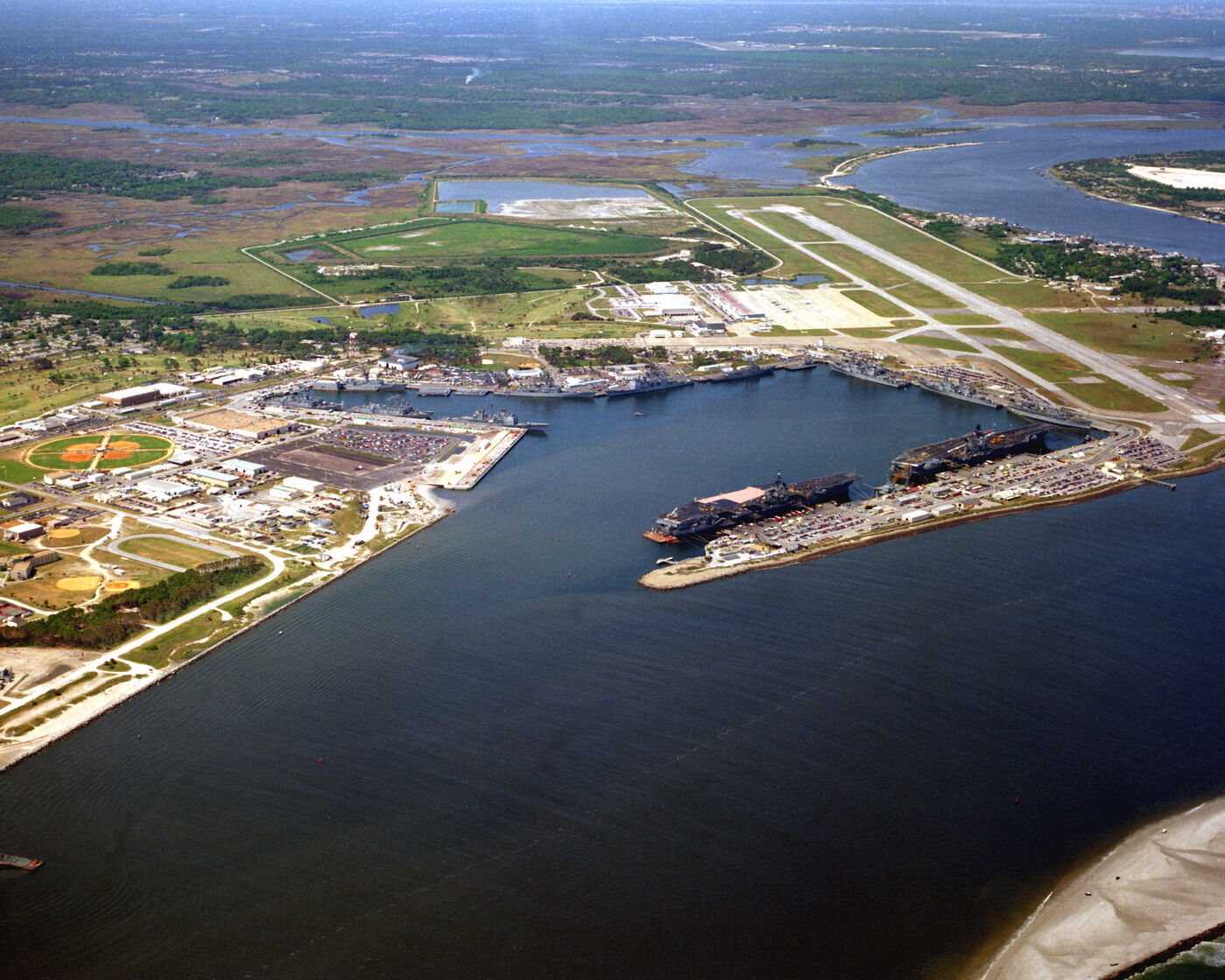
Naval Station Mayport
Naval Station Mayport is an active United States Navy installation located near Jacksonville, in Duval County, Florida, at the mouth of the St. Johns River where it meets the Atlantic Ocean. The base was commissioned in December 1942 during World War II, initially supporting anti-submarine operations and convoy protection along the Atlantic coast. Over the following decades it grew into one of the largest naval ports on the East Coast, with a busy harbor capable of berthing dozens of ships and an airfield able to handle a wide range of aircraft. Mayport has served as homeport to aircraft carriers, destroyers, and guided-missile cruisers, and its present mission centers on sustaining and enhancing warfighter readiness for the Atlantic Fleet. As a large, long-operating installation with both ship and aviation activity, it has accumulated a history of industrial and firefighting practices now associated with environmental concerns.
Like many older military installations, Naval Station Mayport has documented environmental contamination tied to firefighting foam, legacy construction materials, and decades of operations. The contaminants described below have been identified through Navy testing and survey work, and they have raised concerns about potential exposure among service members, civilian workers, and nearby residents.
- PFAS: PFAS (per- and polyfluoroalkyl substances) are a large group of synthetic chemicals often called "forever chemicals" because they break down very slowly and can persist in soil and groundwater. At Mayport, PFAS are associated with the firefighting foam used on the base, and in 2019 the Navy began testing drinking-water wells around the installation and the nearby Whitehouse Naval Outlying Field for these compounds. Exposure to PFAS has been associated in scientific studies with certain cancers, thyroid disease, and reproductive effects.
- PFOS: PFOS (perfluorooctane sulfonate) is one of the most studied PFAS compounds and a common component of older firefighting foams used by the military. It is among the substances of concern in the groundwater and well testing conducted around Mayport. PFOS has been associated with potential health effects similar to other PFAS chemicals, which is why drinking-water levels have drawn close attention.
- PFOA: PFOA (perfluorooctanoic acid) is another well-known PFAS compound historically linked to firefighting foam and industrial uses. It is part of the family of chemicals the Navy screened for in the wells surrounding the base. Research has associated PFOA exposure with concerns about certain cancers and other long-term health effects.
- AFFF: AFFF (aqueous film-forming foam) is a firefighting agent the Navy used for many years to suppress fuel fires during training and emergency response. AFFF is the principal source of the PFAS, PFOS, and PFOA found in the area, and at Mayport the Navy reported limiting foam training exercises, substituting water, and replacing older formulations with versions containing fewer of these chemicals. Concerns about potential exposure relate to the PFAS compounds the foam contains.
- Asbestos: Asbestos is a naturally occurring fibrous mineral once widely used for insulation and fireproofing. Because Mayport was built in the 1940s during a period of heavy asbestos use, the mineral appears in legacy materials such as pipe and spray-on insulation, boilers, floor tiling, and deck coverings, both in base buildings and aboard older ships berthed there. Inhalation of asbestos fibers has been associated with mesothelioma and other respiratory diseases, often many years after exposure.
Naval Station Mayport is not listed on the National Priorities List, so it is not a federal Superfund site. The Environmental Protection Agency nominated the base for investigation in 1994, and environmental work has since proceeded under the Navy's Installation Restoration Program in coordination with the Florida Department of Environmental Protection, following the federal CERCLA and RCRA frameworks. As part of its PFAS response, the Navy offered no-cost well testing and pledged to provide bottled water and pursue permanent solutions where contamination was confirmed, while asbestos abatement has been carried out during building demolition projects.
Veterans, civilian employees, and family members who lived or worked at Naval Station Mayport may wish to stay informed about ongoing testing and cleanup efforts and to keep a record of when and where they served. Anyone with questions about possible exposure or related health concerns is encouraged to speak with a personal physician and to contact the U.S. Department of Veterans Affairs at va.gov, which can provide current guidance on health resources and benefits.
Were you stationed at a contaminated site?
The PACT Act of 2022 added more than 20 presumptive conditions for toxic exposure, including many cancers, and there is no deadline to file a VA claim.
This page is for informational purposes only and is not medical or legal advice. Consult a qualified professional about your health or benefits.
Discussion
No approved comments yet.