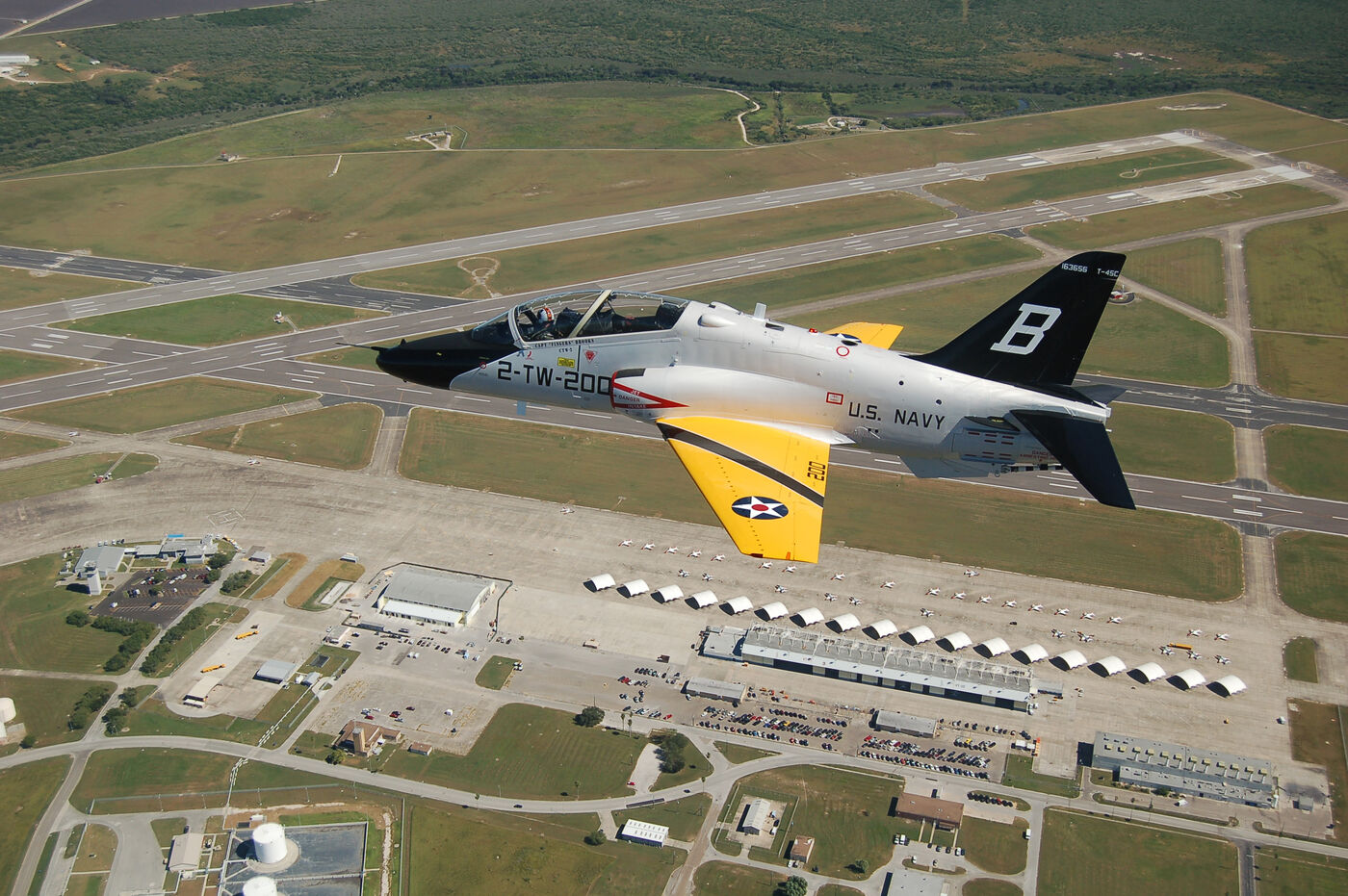
Naval Air Station Kingsville
Naval Air Station Kingsville is an active United States Navy installation located in Kingsville, in Kleberg County, Texas. It was commissioned on July 4, 1942, as a naval auxiliary air station supporting pilot training out of nearby Naval Air Station Corpus Christi during World War II. The base became an all-jet training facility in 1960 and was upgraded to an autonomous naval air station in 1968. Today it is one of the Navy's primary sites for undergraduate jet and strike pilot training, hosting Training Air Wing Two and its squadrons VT-21 and VT-22, which fly the T-45 Goshawk. Each year the station trains aviation students for the Navy, the Marine Corps, and allied nations.
As with many installations that conducted flight operations and firefighting activities over several decades, Naval Air Station Kingsville has been associated with concerns about potential exposure to certain persistent chemicals. The Navy has been investigating per- and polyfluoroalkyl substances in groundwater and drinking water near the base, primarily linked to the historical use of firefighting foam. The following contaminants have been documented in connection with the installation.
- PFAS: PFAS (per- and polyfluoroalkyl substances) are a large family of manufactured chemicals valued for resisting heat, water, and oil. At Naval Air Station Kingsville they are associated with decades of firefighting foam use during training and emergency response. Because these compounds are persistent and mobile in the environment, they have been associated with concerns about potential long term health effects, which remain under scientific study.
- PFOS: PFOS (perfluorooctane sulfonate) is one of the most studied PFAS compounds and was a common ingredient in older firefighting foams used at the base. The Navy's drinking water sampling near Kingsville has focused on PFOS levels relative to federal health advisory guidance, and exposure to PFOS has been associated with possible health concerns in some research.
- PFOA: PFOA (perfluorooctanoic acid) is another widely studied PFAS chemical that has appeared alongside PFOS in foam-related investigations. At Naval Air Station Kingsville it is part of the same sampling program for private wells and drinking water sources, and concerns about potential exposure have prompted protective measures by the Navy.
- AFFF: AFFF (aqueous film-forming foam) is the firefighting foam used to suppress fuel fires during training exercises and emergencies. AFFF historically contained PFAS such as PFOS and PFOA, and its use at the base is the documented source most closely associated with the chemicals now under investigation. Concerns about potential exposure relate chiefly to the migration of these foam components into nearby groundwater.
Naval Air Station Kingsville is not listed on the National Priorities List as a Superfund site. The Navy has carried out a drinking water investigation in coordination with the Texas Commission on Environmental Quality, the Agency for Toxic Substances and Disease Registry Region 6, and the Texas Department of State Health Services. As a protective measure, the Navy has provided bottled water for drinking and cooking to residents in the sampling area whose private wells were found to contain PFOA or PFOS above the Environmental Protection Agency health advisory levels, pending a longer term solution. Investigation and response work has been conducted under the Department of Defense and Navy environmental restoration framework.
Veterans, family members, and former workers who spent time at Naval Air Station Kingsville and have questions about possible exposure are encouraged to stay informed as testing continues. Keeping personal records of service dates and locations can help, and individuals with health concerns may wish to discuss their history with a medical provider and contact the U.S. Department of Veterans Affairs to learn about available benefits.
Were you stationed at a contaminated site?
The PACT Act of 2022 added more than 20 presumptive conditions for toxic exposure, including many cancers, and there is no deadline to file a VA claim.
This page is for informational purposes only and is not medical or legal advice. Consult a qualified professional about your health or benefits.
Discussion
No approved comments yet.