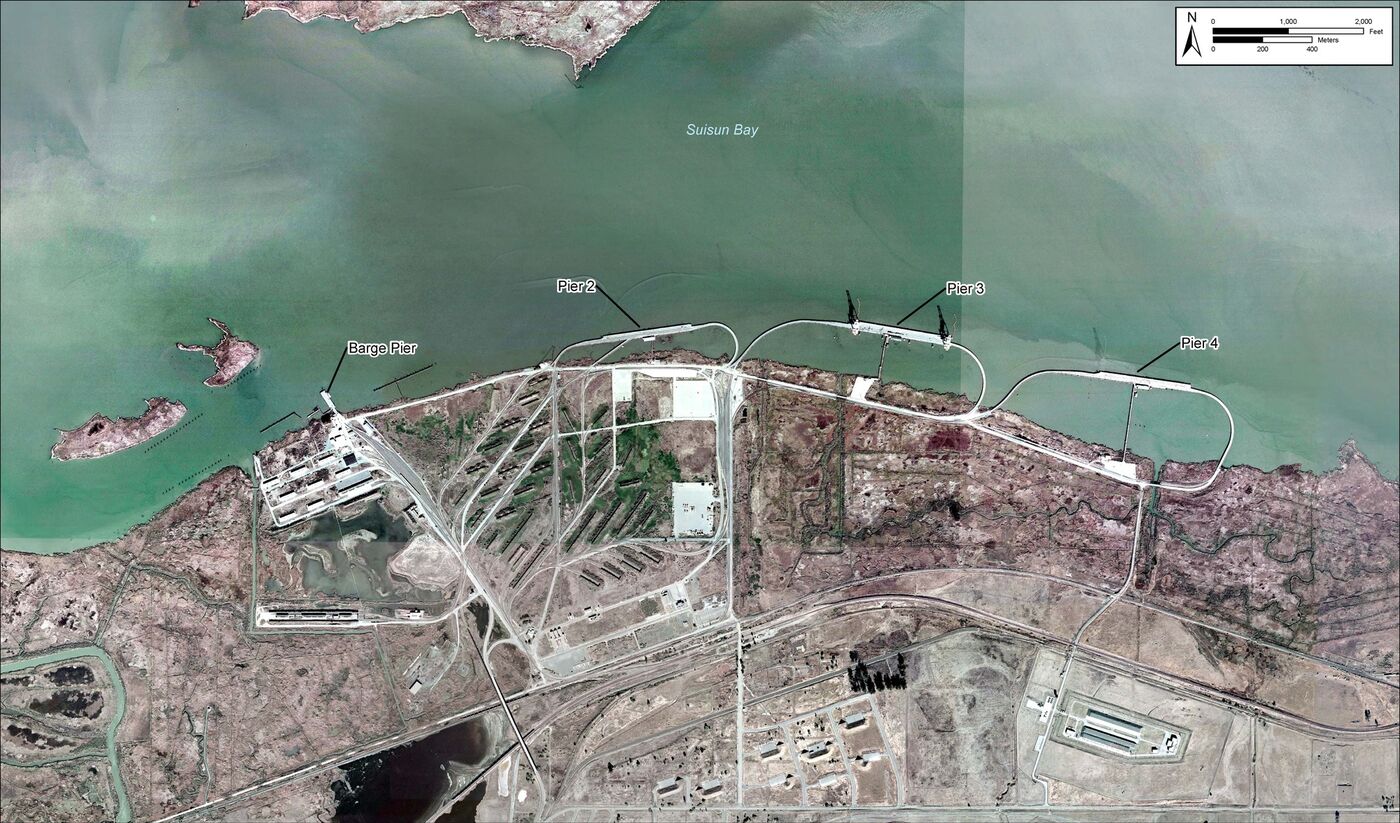
Military Ocean Terminal Concord
Military Ocean Terminal Concord (MOTCO) is a U.S. Army installation in Contra Costa County, California, that serves as a major West Coast ammunition trans-shipment port for the Department of Defense. The site was originally established in 1942 as the Naval Weapons Station Concord (earlier known by other names), making it one of the oldest naval ordnance support facilities on the Pacific Coast. For decades the property, which spans roughly 12,800 acres, was divided into an Inland Area and a waterfront Tidal Area used for handling, storing, and loading weapons and munitions. Following Base Realignment and Closure recommendations, the Tidal Area was transferred to the Army in 2008, while the Navy retained responsibility for environmental work in the Inland Area. The installation's history also includes the 1944 Port Chicago explosion, which remains a significant event associated with the site.
Because of the long history of munitions handling, ordnance disposal, herbicide use, and industrial maintenance, environmental investigations have documented contamination across many areas of the property. Roughly 32 areas were identified as contaminated, and concerns about potential exposure to several substances have prompted ongoing study and cleanup. The following contaminants have been documented in connection with the installation.
- Heavy metals. Investigators have identified zinc, copper, lead, cadmium, and arsenic in soil and sediment at numerous areas, linked in part to munitions handling, ordnance burning, and historical herbicide applications. Exposure to certain heavy metals has been associated with a range of health concerns, and remediation has focused on reducing contact with affected soils.
- Solvents (TCE). Chlorinated solvents, including trichloroethylene, were used in vehicle and equipment maintenance and have been detected in groundwater and soil gas due to past disposal practices. Long-term exposure to TCE has been associated with potential health effects, and the Navy has applied air sparging and soil vapor extraction at several maintenance areas.
- Explosives and napalm. Residues from munitions and explosives, including napalm residue that was excavated from a former inland burn area, are linked to the site's role in ordnance storage, disposal, and handling. Concerns about potential exposure to munitions constituents in soil have been part of the federal cleanup evaluation.
- PFAS. Per- and polyfluoroalkyl substances have been associated with the installation, consistent with the historical use of AFFF firefighting foam at military fire-training and emergency-response areas. Concerns about potential exposure to PFAS in groundwater have led the military to assess these compounds under its broader PFAS investigation efforts.
The Concord Naval Weapons Station was added to the Environmental Protection Agency's National Priorities List as a federal Superfund site on December 16, 1994. Cleanup is conducted under a federal facility agreement, with the Navy addressing the Inland Area and the Army addressing the Tidal Area. Work has included groundwater treatment, soil vapor extraction, and removal actions, while some areas continue to await additional studies or records of decision.
Veterans who served at Military Ocean Terminal Concord or the former Concord Naval Weapons Station may wish to stay informed as cleanup continues and as research into these contaminants evolves. Anyone with questions about possible exposure and related health concerns is encouraged to speak with the U.S. Department of Veterans Affairs, which can provide current guidance on available benefits and health resources.
Were you stationed at a contaminated site?
The PACT Act of 2022 added more than 20 presumptive conditions for toxic exposure, including many cancers, and there is no deadline to file a VA claim.
This page is for informational purposes only and is not medical or legal advice. Consult a qualified professional about your health or benefits.
Discussion
No approved comments yet.