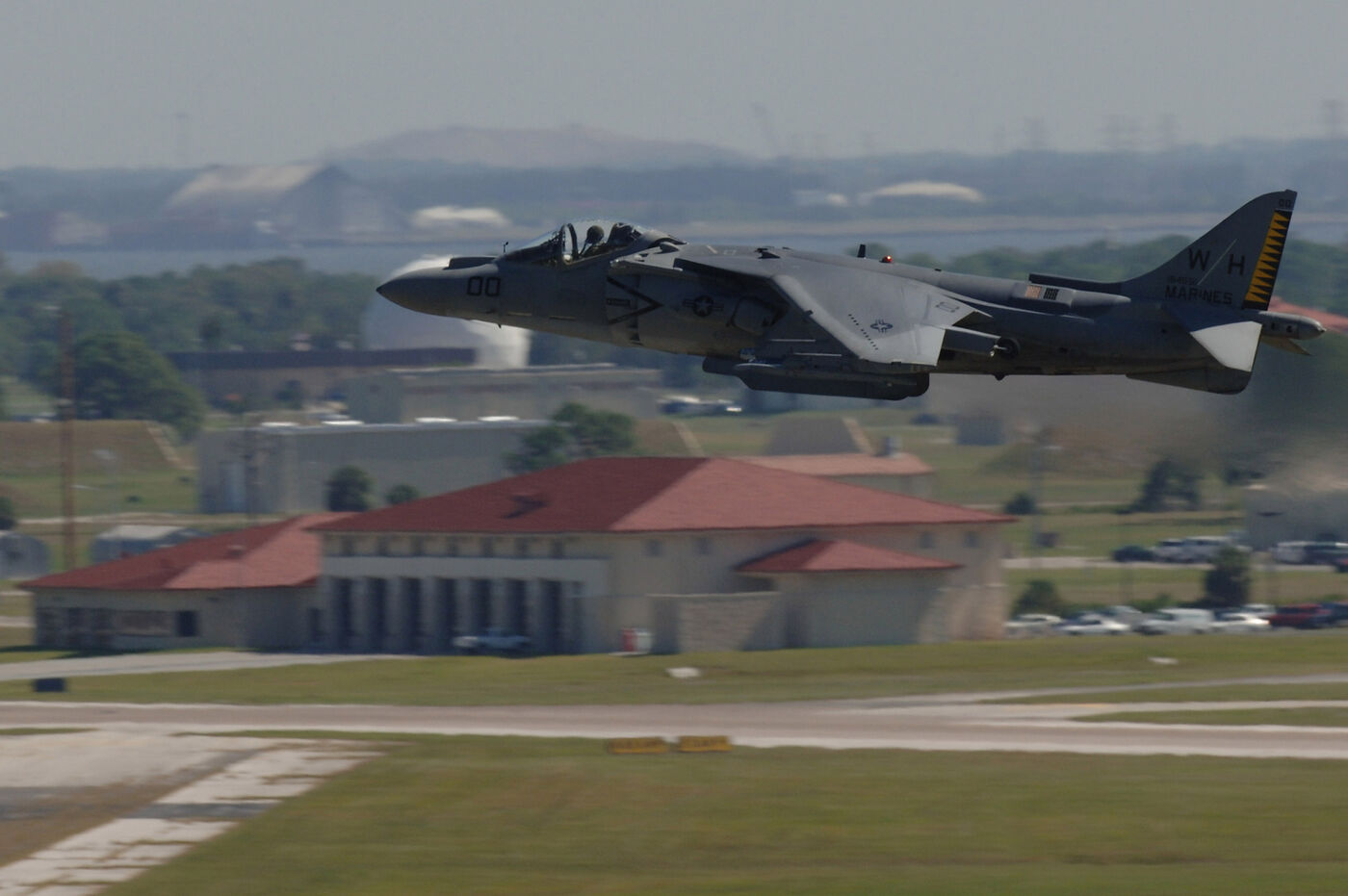
MacDill Air Force Base
MacDill Air Force Base is an active United States Air Force installation located on the Interbay Peninsula just south of Tampa, Florida. Construction began in 1939 on what was first known as Southeast Air Base, and the field was dedicated as MacDill Army Air Field on April 16, 1941, named for Colonel Leslie MacDill, a World War I aviator. It was redesignated MacDill Air Force Base after the Air Force became an independent service in 1947. For much of its history the base trained aircrews and supported air operations over the Gulf of Mexico, and today it is home to the 6th Air Refueling Wing, which flies the KC-135 Stratotanker, as well as major tenant commands including United States Central Command and United States Special Operations Command.
Like many long-active military airfields, MacDill has been the subject of concerns about potential environmental contamination tied to decades of flight-line and fire-training activity. Investigators have focused in particular on a family of synthetic chemicals associated with firefighting foam, and the base has been described as an active PFAS investigation site in Florida.
- PFAS. PFAS are a large group of synthetic "forever chemicals" valued for their resistance to heat, water, and oil and known for their persistence in the environment and in the human body. At MacDill, PFAS have been detected in groundwater and are believed to be associated with the routine use of firefighting foam during training and emergency response. PFAS exposure has been associated in some studies with a range of potential health effects, which is one reason these chemicals remain under investigation.
- PFOS. PFOS is one of the most studied individual PFAS compounds and a primary ingredient of legacy firefighting foams. Sampling reported in the waters bordering MacDill found elevated PFOS in oysters, and the compound has been a focus of groundwater testing at the installation. Concerns about potential PFOS exposure stem from its tendency to accumulate over time.
- PFOA. PFOA is a related perfluorinated compound that Florida environmental regulators have identified, alongside PFOS, as a chemical of interest when reviewing historic foam discharges at military sites. It is among the substances being evaluated as part of the ongoing PFAS work at the base, and exposure has been associated with potential health concerns in scientific literature.
- AFFF. AFFF, or aqueous film-forming foam, is the firefighting product believed to be the principal source of PFAS, PFOS, and PFOA at MacDill. The foam was used to suppress fuel fires during training exercises and emergency operations, and its repeated application is the activity most often linked to the groundwater contamination now under study. Concerns about AFFF center on the long-lasting chemicals it can leave behind.
MacDill is not listed on the National Priorities List as a federal Superfund site. Instead, environmental work is proceeding under the Department of Defense cleanup program, in coordination with the Florida Department of Environmental Protection, which works with the military on historic AFFF discharges at federal facilities in the state. According to available information, a remedial investigation is underway to help define the extent of contamination and to guide any future response actions.
Veterans, civilian employees, and family members who lived or worked at MacDill may wish to stay informed as the investigation continues and new findings are released. Those who have questions about possible exposure are encouraged to keep records of their service history and to speak with the U.S. Department of Veterans Affairs about available health resources and benefits.
Were you stationed at a contaminated site?
The PACT Act of 2022 added more than 20 presumptive conditions for toxic exposure, including many cancers, and there is no deadline to file a VA claim.
This page is for informational purposes only and is not medical or legal advice. Consult a qualified professional about your health or benefits.
Discussion
No approved comments yet.