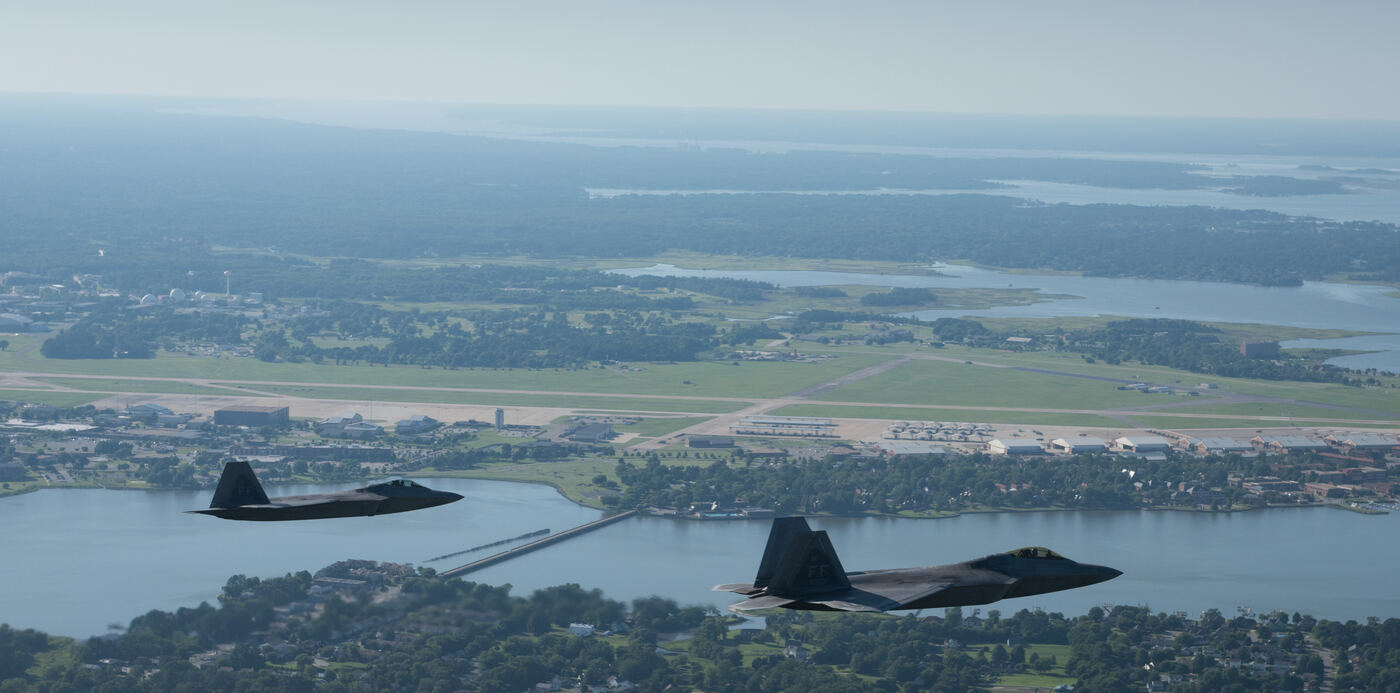
Joint Base Langley-Eustis
Joint Base Langley-Eustis is a joint Air Force and Army installation in the Hampton Roads region of southeastern Virginia, created in October 2010 when Langley Air Force Base and Fort Eustis were consolidated under the 2005 Base Realignment and Closure process. Langley, established in December 1916 and named for aviation pioneer Samuel Pierpont Langley, is one of the oldest continuously operating air bases in the country and sits adjacent to the NASA Langley Research Center in Hampton. Fort Eustis, founded in 1918 near Newport News, has long served as the Army's hub for transportation and logistics training.
Both components of the joint base have documented environmental contamination, and each was added to the EPA's Superfund National Priorities List in 1994. Investigations have identified dozens of potential contamination sources, including former landfills, fire training areas, fueling operations, and maintenance facilities. Testing conducted in 2017 and 2018 detected firefighting foam chemicals in groundwater at concentrations among the highest reported at any U.S. military installation. The following contaminants have been documented at the base:
- PFAS (per- and polyfluoroalkyl substances) are persistent synthetic chemicals often called "forever chemicals" because they break down very slowly. PFAS have been detected in groundwater at both Langley and Fort Eustis, and both sites appear on the EPA's list of Superfund sites with PFAS contamination. Exposure to PFAS has been associated in some studies with certain cancers, thyroid conditions, and immune system effects.
- PFOS is one of the most studied PFAS compounds and a key ingredient in legacy firefighting foams used on flightlines and in training exercises at the base. Testing reported in 2018 found combined PFOS and PFOA in groundwater at Langley as high as 2,225,000 parts per trillion, far above federal health advisory levels.
- PFOA, another widely studied PFAS chemical, was detected alongside PFOS in groundwater at both installations, with combined PFOS and PFOA readings at Fort Eustis reported as high as roughly 77,600 parts per trillion. PFOA exposure has been associated in research with kidney and testicular cancer, among other potential health effects.
- AFFF (aqueous film forming foam) is the PFAS-based firefighting foam the military has used since the 1970s to suppress fuel fires. Decades of AFFF use in aircraft rescue operations and fire training at Langley and Fort Eustis are considered the primary source of the PFAS found in groundwater at the joint base.
- Industrial solvents and other hazardous chemicals were used in vehicle, aircraft, and equipment maintenance at both installations. According to the EPA, spills and historical disposal practices contaminated soil, sediment, surface water, and groundwater, and concerns remain about potential past exposure for those who lived and worked on base.
Cleanup at Joint Base Langley-Eustis is ongoing under the federal Superfund program. Fort Eustis was listed on the National Priorities List in December 1994, and the Langley Air Force Base/NASA Langley Research Center site was listed in May 1994. Work proceeds under Federal Facilities Agreements among the EPA, the Virginia Department of Environmental Quality, the Army, the Air Force, and NASA, covering 18 operable units at Fort Eustis and more than 30 across Langley and the NASA center. Completed actions include landfill capping, excavation of contaminated soil and sediment, and institutional controls, while PFAS investigation continues under CERCLA.
Veterans and family members who spent time at Langley Air Force Base, Fort Eustis, or the combined joint base may wish to stay informed as environmental investigations continue. Anyone with questions about potential past exposure or related health concerns can speak with a VA health care provider and review VA guidance on environmental exposures, which may evolve as new information becomes available.
Were you stationed at a contaminated site?
The PACT Act of 2022 added more than 20 presumptive conditions for toxic exposure, including many cancers, and there is no deadline to file a VA claim.
This page is for informational purposes only and is not medical or legal advice. Consult a qualified professional about your health or benefits.
Discussion
No approved comments yet.