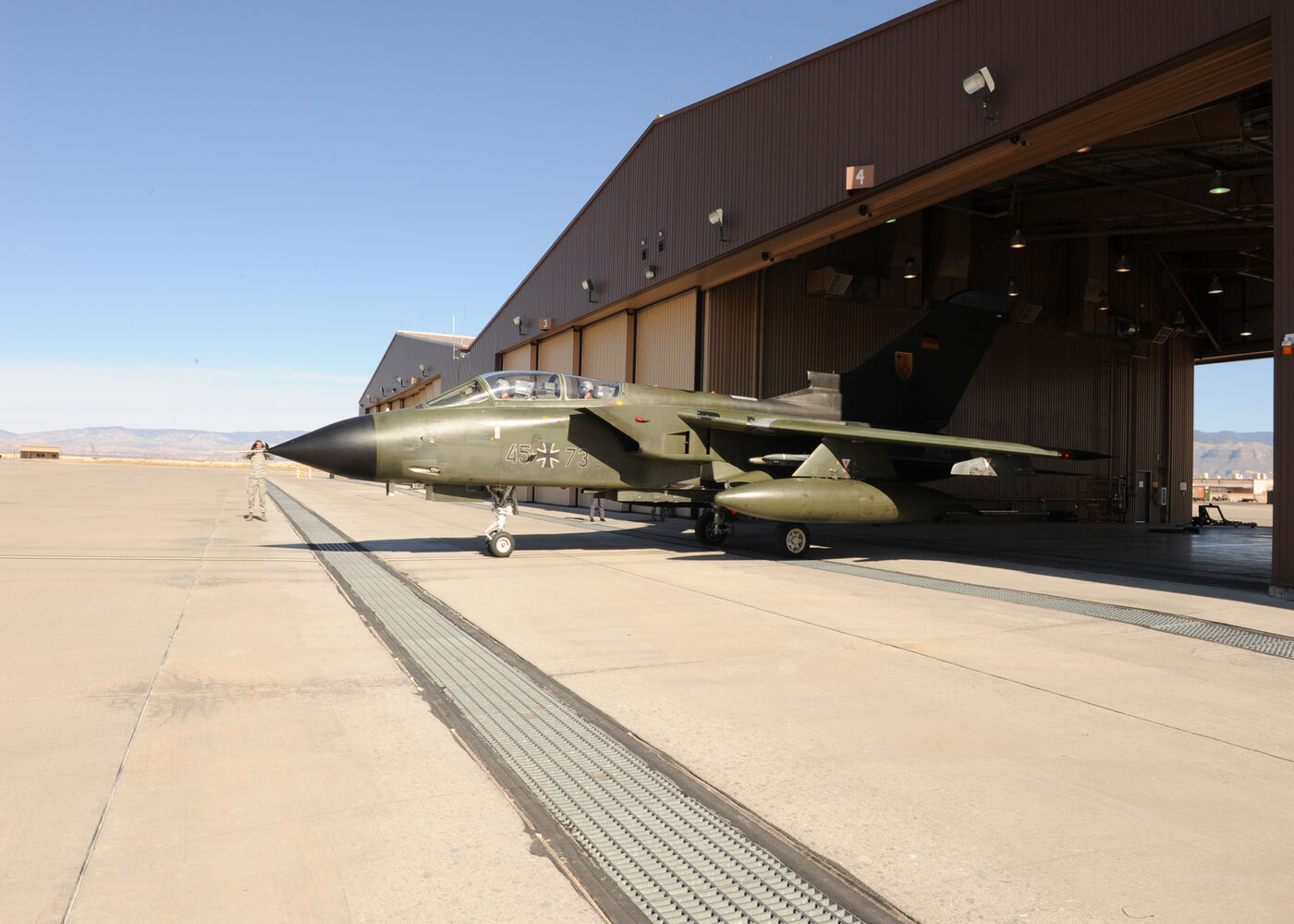
Holloman Air Force Base
Holloman Air Force Base is a United States Air Force installation in the Tularosa Basin of southern New Mexico, near the city of Alamogordo. It was established on June 10, 1942, as Alamogordo Army Air Field and initially served as a training site for bomber crews flying aircraft such as the B-17, B-24, and B-29 during the Second World War. In 1948 the base was renamed in honor of Colonel George Holloman, a pioneer of early rocket and pilotless aircraft research, reflecting the installation's postwar shift toward missile and aircraft testing and development. Holloman has since remained an active flying and training base, and its long operational history has involved a range of aircraft, fuels, and industrial materials.
As with many long-established military airfields, activities at Holloman Air Force Base have raised concerns about potential exposure to certain chemicals, particularly those associated with firefighting operations. Environmental investigations have documented contamination that regulators and researchers continue to study, and these findings have prompted ongoing review by state and federal authorities.
- AFFF (aqueous film forming foam) is a firefighting foam that was used at Holloman for training exercises and emergency response, reportedly from roughly the 1970s until it was phased out around 2019. AFFF was the principal source of the fluorinated chemicals later detected on and near the base. Exposure to AFFF has been associated in some studies with health concerns connected to the chemical compounds it contains.
- PFAS (per- and polyfluoroalkyl substances) are a large family of synthetic chemicals present in the AFFF used at the base. Groundwater sampling at Holloman has reported PFAS concentrations as high as 1,294,000 parts per trillion, far above former federal advisory levels, and researchers have measured record PFAS levels in wildlife around nearby Holloman Lake. PFAS are persistent in the environment, and research has associated certain PFAS exposures with a variety of potential health effects.
- PFOS (perfluorooctanesulfonic acid) is one of the specific PFAS compounds historically found in older AFFF formulations. It is among the substances examined in environmental sampling tied to the foam release areas at the base. PFOS has been associated in some studies with concerns about potential health effects following sustained exposure.
- PFOA (perfluorooctanoic acid) is another individual PFAS compound of concern connected to legacy firefighting foam. Along with PFOS, PFOA was designated by the U.S. Environmental Protection Agency as a hazardous substance under federal cleanup law in 2024. Research has associated PFOA exposure with concerns about potential health effects, and it remains a focus of continuing investigation.
Holloman Air Force Base is not listed on the EPA National Priorities List as a Superfund site. Investigation and cleanup activities are overseen by the New Mexico Environment Department's Hazardous Waste Bureau, which issued a notice of violation in 2019 regarding PFAS in groundwater and has tracked phased PFAS investigation reports and corrective action work at the facility. The base is also among the New Mexico installations named in litigation by the state, where the New Mexico Attorney General filed an amended complaint in July 2024 seeking cleanup costs and damages from the Department of Defense under federal regulations.
Veterans and family members who served or lived at Holloman Air Force Base may wish to stay informed as environmental investigations and related proceedings continue. Anyone with questions about possible exposure or related health concerns is encouraged to speak with the U.S. Department of Veterans Affairs and a personal health care provider, who can offer guidance based on individual circumstances.
Were you stationed at a contaminated site?
The PACT Act of 2022 added more than 20 presumptive conditions for toxic exposure, including many cancers, and there is no deadline to file a VA claim.
This page is for informational purposes only and is not medical or legal advice. Consult a qualified professional about your health or benefits.
Discussion
No approved comments yet.