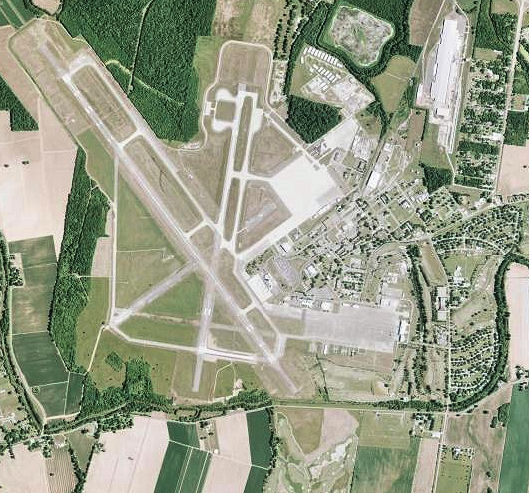
Former England Air Force Base
The former England Air Force Base sits just outside Alexandria in central Louisiana. The installation began in 1942 as Alexandria Army Air Base and was used during World War II to train B-17 and later B-29 bomber crews. In 1955 it was renamed in honor of Lt. Col. John B. England, and through the Cold War it served as a fighter and tactical airlift installation. The base was selected for closure under the Base Realignment and Closure (BRAC) process and shut down on December 15, 1992. The property has since been redeveloped into Alexandria International Airport and the England Airpark, a mix of aviation, commercial, and light industrial use.
As with many long-operating airfields, decades of flight operations, maintenance, fuel handling, and firefighting activity left a record of environmental contamination. Investigations at the former base have documented several substances of concern in groundwater and soil, and some of the findings have drawn national attention because of their reported magnitude.
- PFAS: PFAS are a large family of synthetic "forever chemicals" that resist breakdown in the environment and the body. At England, PFAS contamination has been traced primarily to firefighting foam used at fire training areas. Testing reported in 2016 recorded a PFHxS concentration of about 20.7 million parts per trillion, among the highest PFAS detections reported at any U.S. military site. PFAS exposure has been associated in some studies with effects on the liver, immune system, and certain cancers, though findings vary.
- PFOS: PFOS is one of the most studied PFAS compounds and was a primary ingredient in older firefighting foam formulations used on the base. Concerns about potential PFOS exposure relate to its persistence and its tendency to accumulate over time.
- PFOA: PFOA is another PFAS compound historically present in some foam and industrial products. Like related substances, it has been the subject of research into possible long-term health effects, and it is regulated at very low concentrations in drinking water.
- AFFF: AFFF, or aqueous film-forming foam, was the firefighting agent used at the base to suppress fuel fires during training and emergency response. Because older AFFF formulations contained PFOS and PFOA, repeated use at fire training areas is understood to be the main pathway by which these chemicals entered the groundwater.
England is not listed on the federal National Priorities List (Superfund). Environmental restoration has been carried out under the military's base closure cleanup process, and remediation of chlorinated solvent contamination in groundwater, including trichloroethylene, has continued under a permit issued by the Louisiana Department of Environmental Quality (LDEQ). Work has addressed former landfills, spill sites, underground storage tanks, fuel pipelines, and fire training areas across the property.
Veterans, civilian employees, and family members who lived or worked at England Air Force Base may wish to stay informed as PFAS science and federal cleanup standards continue to develop. Anyone with concerns about potential exposure is encouraged to keep personal service records, follow updates from official sources, and speak with the U.S. Department of Veterans Affairs about health and benefit programs that may apply.
Were you stationed at a contaminated site?
The PACT Act of 2022 added more than 20 presumptive conditions for toxic exposure, including many cancers, and there is no deadline to file a VA claim.
This page is for informational purposes only and is not medical or legal advice. Consult a qualified professional about your health or benefits.
Discussion
No approved comments yet.