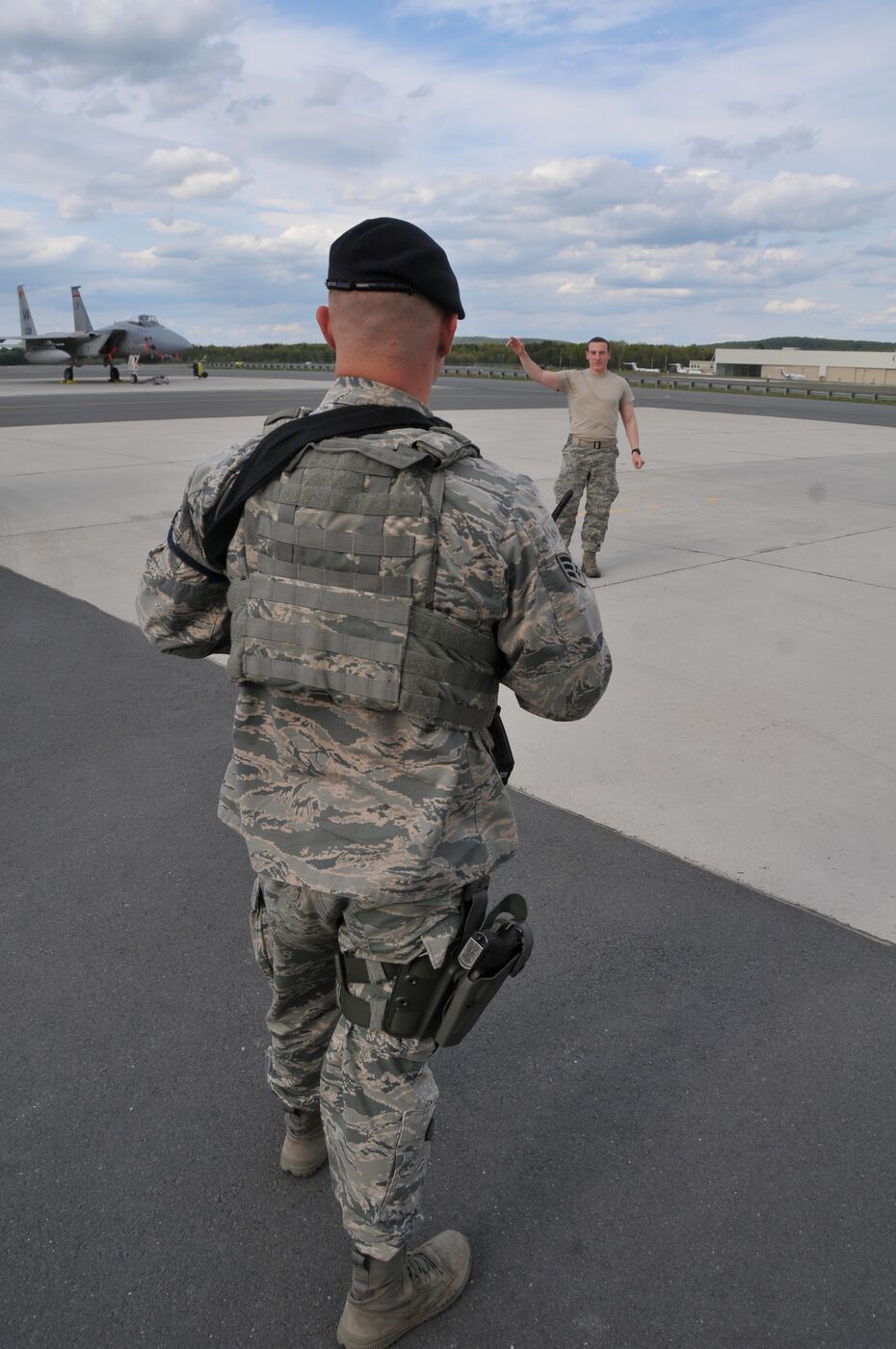
Barnes Air National Guard Base
Barnes Air National Guard Base is a Massachusetts Air National Guard installation located at Barnes Regional Airport in Westfield, in Hampden County. The Air National Guard presence at the airfield dates to October 1946, and the 104th Observation Squadron was established there in 1947. Today the base is home to the 104th Fighter Wing, which carries a dual mission of providing combat-ready forces for federal operations and supporting the Governor of Massachusetts during state emergencies. The wing maintains a 24-hour air sovereignty alert mission protecting the Northeast corridor of the United States. After flying the F-15C Eagle from 2007 until October 2025, the wing began transitioning to the F-35A Lightning II, with the first aircraft expected in the summer of 2026.
Like many airfields where aircraft and fire response operations are based, Barnes has been the subject of concerns about potential exposure to chemicals used in firefighting and fire training. Groundwater beneath and around the installation has been studied because of contaminants that have been associated with these activities, and some of that groundwater appears to have migrated off base into Westfield's municipal and private drinking-water supplies.
- AFFF (Aqueous Film Forming Foam): AFFF is a firefighting foam used to suppress fuel fires and in fire-training exercises. According to the ATSDR, Barnes Air National Guard Base used AFFF as early as the 1980s for firefighter training. Because AFFF is the primary source of the per- and polyfluoroalkyl compounds discussed below, its historical use has been associated with concerns about long-term groundwater contamination in the area.
- PFAS (per- and polyfluoroalkyl substances): PFAS are a large family of synthetic chemicals valued for their water- and grease-resistant properties and used in AFFF. PFAS were first detected in the Westfield water system in 2013, and the contamination has been associated with AFFF use at the base. Research has associated certain PFAS exposures with a range of potential health effects, which is why blood and water testing in the community has drawn attention.
- PFOS (perfluorooctane sulfonate): PFOS is an individual PFAS compound historically present in AFFF formulations. The ATSDR exposure assessment reported that some PFAS, including PFOS, were measured in the blood of Westfield residents at levels up to about four times higher than national averages. Elevated PFOS exposure has been associated in some studies with concerns about immune and other health effects.
- PFOA (perfluorooctanoic acid): PFOA is another individual PFAS compound that was among those found at elevated levels in the Hampden County assessment. PFOA exposure has been associated in scientific reviews with potential health concerns, and like PFOS it persists in the environment and the body for extended periods.
Barnes Air National Guard Base is not listed on the National Priorities List as a federal Superfund site. Instead, response and cleanup have proceeded under the Department of Defense environmental program in coordination with the Massachusetts Department of Environmental Protection (MassDEP) and the City of Westfield. Affected municipal wells were taken offline in 2015 and 2016, and by 2016 the drinking water was reported to meet the EPA health advisory levels then in effect. Those wells were later returned to service with granular activated carbon treatment systems, and the Air National Guard has undertaken a remedial investigation to map the extent and depth of the contamination plume, a process expected to continue for several years.
Veterans, civilian employees, and family members who lived or worked at or near Barnes Air National Guard Base may wish to stay informed about ongoing environmental monitoring and any updates from the ATSDR and MassDEP. Anyone with questions about possible exposure and their health is encouraged to speak with the U.S. Department of Veterans Affairs and a personal healthcare provider, who can offer guidance based on individual circumstances.
Were you stationed at a contaminated site?
The PACT Act of 2022 added more than 20 presumptive conditions for toxic exposure, including many cancers, and there is no deadline to file a VA claim.
This page is for informational purposes only and is not medical or legal advice. Consult a qualified professional about your health or benefits.
Discussion
No approved comments yet.