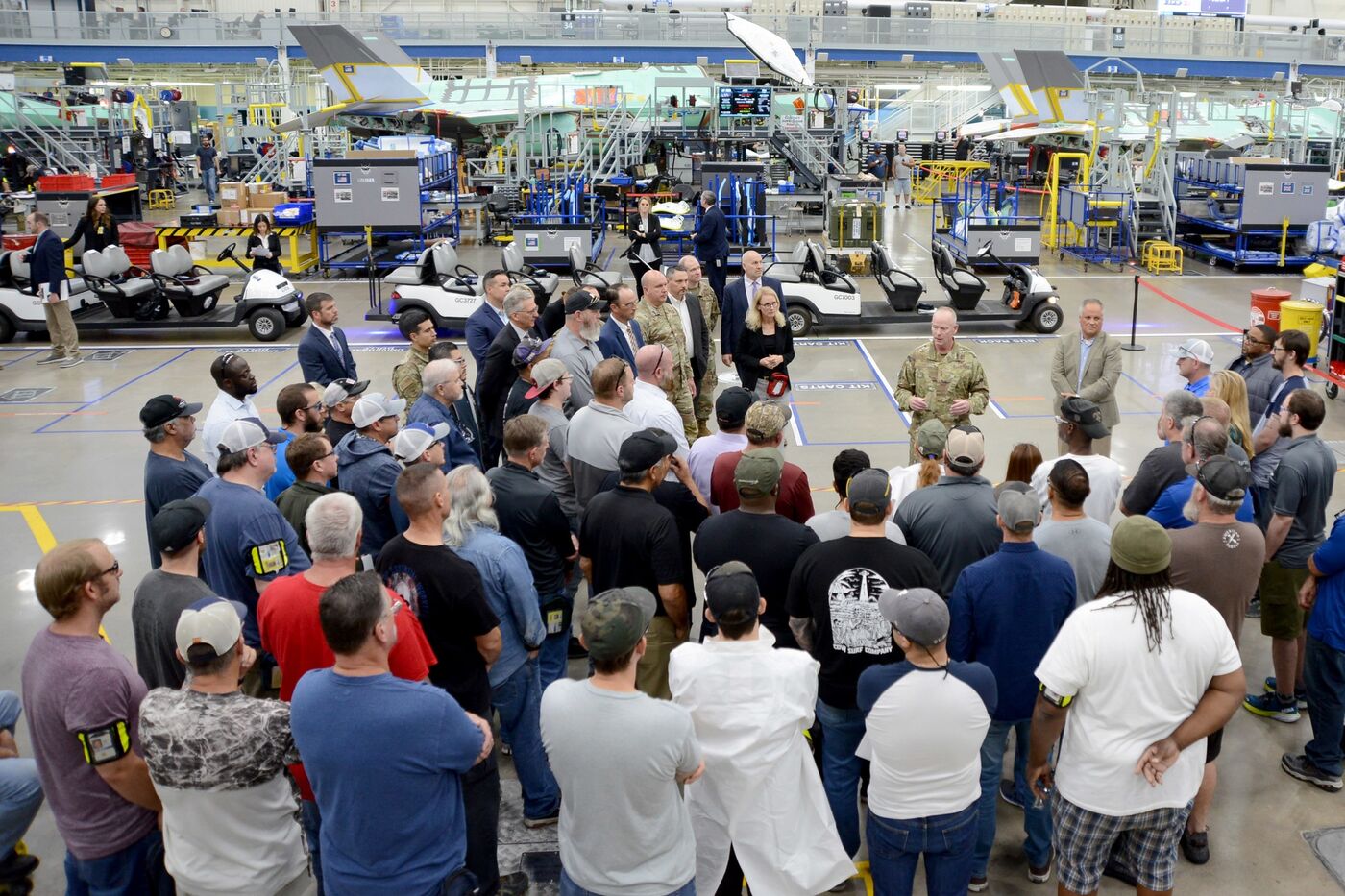
Air Force Plant 4
Air Force Plant 4 is a government-owned, contractor-operated military aircraft manufacturing facility in Fort Worth, Tarrant County, Texas. The plant was built in 1941 and became operational in 1942, originally producing B-24 Liberators for the war effort. Over the decades it has been operated by Consolidated Aircraft, Convair, General Dynamics, and currently Lockheed Martin Aeronautics, and it has assembled aircraft such as the B-36 Peacemaker, B-58 Hustler, F-111 Aardvark, F-16 Fighting Falcon, and components for the F-22 and F-35. The facility sits adjacent to Naval Air Station Joint Reserve Base Fort Worth, the former Carswell Air Force Base, on the city's west side. Aircraft production at the site supported a large workforce and remains a major regional employer.
As with many long-running aerospace and defense installations, industrial operations at Air Force Plant 4 have been associated with the release of chemicals into soil and groundwater, raising concerns about potential exposure for workers and nearby communities. The site is defined in large part by a base-wide groundwater plume that migrated toward the adjacent Carswell Field. Several categories of contaminants have been documented in connection with the plant.
- Trichloroethylene: TCE is a chlorinated solvent that was widely used at the plant to clean and degrease aircraft metal parts. It is the primary contaminant defining the base-wide groundwater plume beneath Air Force Plant 4 and the adjacent naval air station. Exposure to TCE has been associated with concerns about effects on the liver, kidneys, immune system, and certain cancers.
- Per- and polyfluoroalkyl substances: PFAS are a group of long-lasting synthetic chemicals historically found in firefighting foams and industrial applications at military airfields. The Air Force began a remedial investigation for PFAS at the site in July 2024 to sample groundwater, soils, and sediments and determine the extent of any contamination. PFAS have been associated with concerns about potential effects on cholesterol, the immune system, and certain cancers.
- Industrial solvents: Beyond TCE, a range of volatile organic solvents was used in manufacturing, parts cleaning, and maintenance. Degradation products such as cis- and trans-dichloroethylene and vinyl chloride have been monitored in groundwater at the site. Long-term exposure to such solvents has been associated with concerns about potential effects on the nervous system and other organs.
- Heavy metals: Metals including chromium have been documented in groundwater and surface water at the plant, tied to metal finishing and related industrial processes. Certain heavy metals, including some forms of chromium, have been associated with concerns about potential effects on the kidneys, lungs, and other systems depending on the level and route of exposure.
Air Force Plant 4 was proposed for the EPA National Priorities List, the federal Superfund program, in 1984 and formally added to the list in 1990. Cleanup has focused on the TCE groundwater plume. In 1996 the Air Force planted hundreds of cottonwood trees to help draw down shallow contamination, and in 2002 it installed a permeable reactive barrier across the leading edge of the plume. The site achieved Construction Completion on September 15, 2006, and long-term monitoring of groundwater and surface water continues, with the more recent PFAS investigation underway since 2024.
Veterans, civilian employees, and family members who spent time at or near Air Force Plant 4 may wish to stay informed as environmental investigations continue and new findings emerge. Anyone with questions about possible exposure or related health concerns is encouraged to speak with the U.S. Department of Veterans Affairs and a personal healthcare provider, who can offer guidance based on individual circumstances.
Were you stationed at a contaminated site?
The PACT Act of 2022 added more than 20 presumptive conditions for toxic exposure, including many cancers, and there is no deadline to file a VA claim.
This page is for informational purposes only and is not medical or legal advice. Consult a qualified professional about your health or benefits.
Discussion
No approved comments yet.