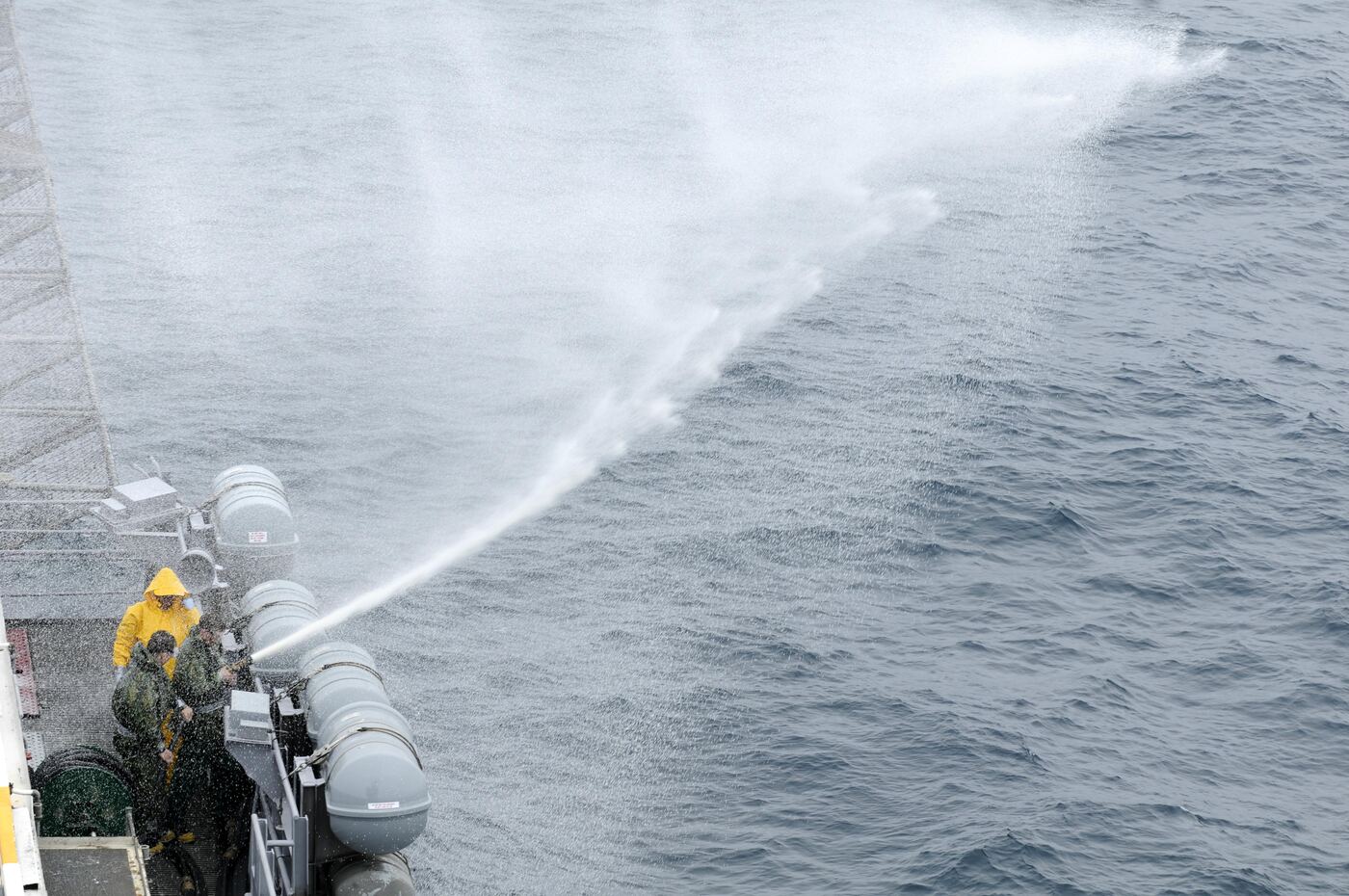
The Military Moves Away From AFFF Firefighting Foam
For roughly half a century, aqueous film-forming foam, better known as AFFF, was the military's go-to weapon against fuel fires. Developed by the Navy in the 1960s and used across every service since the 1970s, the foam smothers burning jet fuel quickly and reliably. It also contains PFAS, the so-called "forever chemicals" that persist in soil, water, and the human body. According to the Government Accountability Office, exposure to certain PFAS compounds may have adverse effects on human health, and the chemicals have been associated in research with kidney and testicular cancers, among other conditions. That legacy is why the Department of Defense is now in the middle of one of the largest firefighting equipment transitions in its history.
A Congressional Mandate and a New Specification
The turning point came in the National Defense Authorization Act for Fiscal Year 2020. Congress required the Pentagon to stop using AFFF at its installations after October 1, 2024, with the option of two one-year waivers that could extend use no later than October 1, 2026. Shipboard use aboard Navy vessels was exempted, a recognition that fires at sea present unique survival risks. The law also pushed DoD to develop a PFAS-free replacement that could meet military performance standards.
That replacement arrived on paper in January 2023, when the department published MIL-PRF-32725, the military specification for fluorine-free foam, or F3, for land-based applications. Manufacturers could then submit products for testing, and foams that pass are added to the department's Qualified Products List. The first F3 concentrate was qualified in 2023, and by 2025 the department reported that six F3 products were available for purchase. The Federal Aviation Administration has followed the military's lead, approving MIL-PRF-32725 foams for use at civilian airports as well.
Where the Transition Stands
The scale of the job is enormous. GAO reported that DoD used AFFF in about 1,500 facilities and more than 6,800 mobile assets worldwide, from hangar fire suppression systems to crash trucks, and estimated the cost of the transition at more than 2.1 billion dollars. F3 is not a simple drop-in replacement everywhere. Some qualified foams cannot be premixed with water in advance, have temperature limitations, or are incompatible with certain tactical systems, and firefighters need retraining because the new foams behave differently on a burning fuel surface.
Progress has been real but slower than the original deadline. Fluorine-free foam began flowing to Air Force bases in 2023 and 2024 as crash trucks and facility systems were drained, cleaned, and refilled. Still, the department invoked both allowable waivers. The first extended the deadline to October 1, 2025, and in a July 2025 letter, Secretary of Defense Pete Hegseth granted the second and final waiver, moving the statutory cutoff to October 1, 2026. The letter described the remaining work as a methodical and safe transition of roughly 1,000 facilities and more than 6,000 mobile assets, citing supply constraints and the need to protect life and safety during the changeover. Barring new legislation, land-based AFFF use at installations must end this fall.
Why It Matters for Firefighters and Base Communities
The people with the most at stake are military firefighters, who for decades handled AFFF in training exercises, equipment tests, and crash responses. A study highlighted by the National Cancer Institute, conducted with the Uniformed Services University, found that elevated blood levels of PFOS were associated with a higher risk of testicular cancer among Air Force servicemen, and that those with higher PFAS concentrations had often served as firefighters or been stationed at bases with contaminated water. The Department of Veterans Affairs notes that PFAS exposure may be associated with several health effects, including testicular and kidney cancer, while cautioning that the overall evidence remains inconclusive. There is currently no presumptive service connection for PFAS-related conditions, so claims are evaluated case by case. Veterans with concerns can speak with a VA Environmental Health Coordinator, and our resources page outlines additional steps.
The Cleanup That Remains
Switching foams stops new releases, but it does not undo decades of old ones. DoD has identified more than 700 installations where PFAS was used or may have been released, and GAO reported in 2025 that future investigation and cleanup costs are estimated at more than 9.3 billion dollars, a figure that has more than tripled since 2022. As of mid-2024, no location had yet entered the long-term cleanup phase, and the department's updated timetables have pushed some investigation milestones back by years. Even disposing of leftover AFFF concentrate is complicated, since incineration and landfilling of PFAS waste raise their own environmental questions.
The move to fluorine-free foam is a genuine milestone, the end of new PFAS firefighting releases at hundreds of military bases. For the firefighters and families who lived and worked around the old foam, though, the transition is less an ending than the start of a long accounting, one measured in groundwater tests, health studies, and cleanup budgets for years to come.
This page is for informational purposes only and is not medical or legal advice. Consult a qualified professional about your health or benefits.
Discussion
No approved comments yet.