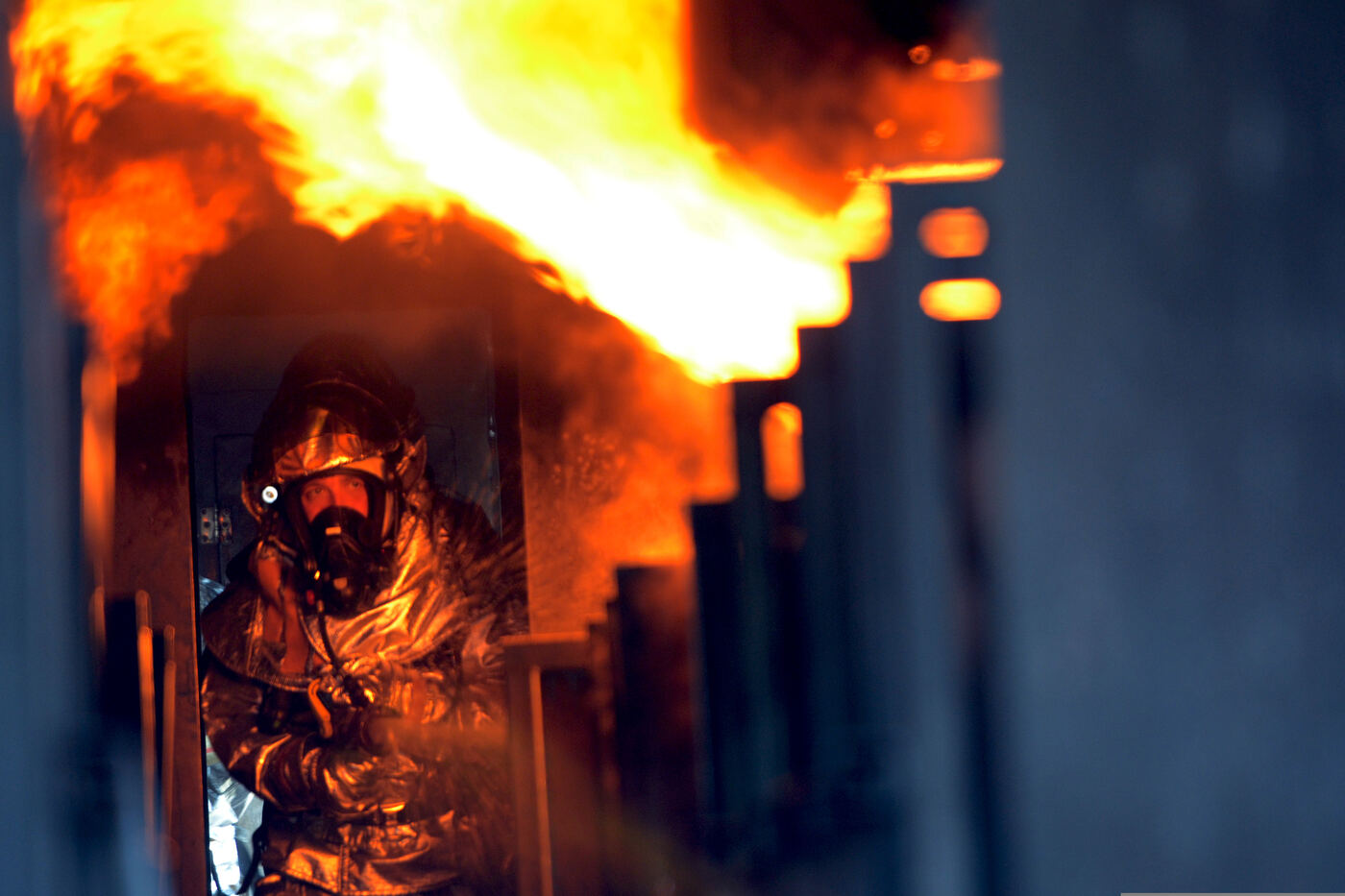
Military Firefighters and PFAS: The Highest Exposure Job
For decades, the people most likely to come into direct contact with firefighting foam on a military installation were the firefighters themselves. Their job placed them at the center of a now well documented exposure problem, and researchers continue to study what that has meant for their long term health. The chemicals at issue are per- and polyfluoroalkyl substances, a large family of compounds commonly called PFAS, sometimes nicknamed forever chemicals because they break down very slowly in the environment and in the human body.
The principal source on bases was aqueous film-forming foam, known as AFFF, a product the military relied on to smother fuel fires. Older formulations contained PFAS, including PFOS and PFOA. Firefighters did not only encounter the foam during emergencies. They used it during repeated training burns, handled and maintained equipment that dispensed it, and worked and slept in stations where residue could accumulate in dust and water. Many bases later identified contaminated groundwater and drinking water near fire training areas, which meant exposure could continue well beyond any single incident.
What blood testing has shown
In the fiscal year 2021 National Defense Authorization Act, Congress directed the Department of Defense to offer PFAS blood testing to active duty military firefighters. The early results gave a sense of how widespread internal exposure had become. Among more than 9,000 firefighters who requested testing in fiscal year 2021, roughly 96 percent had at least one of two measured PFAS compounds detectable in their blood serum, according to reporting by KFF Health News. PFOS was the most commonly detected, at an average of about 3.1 nanograms per milliliter.
Interpreting those numbers is not straightforward. A committee of the National Academies of Sciences, Engineering, and Medicine has suggested that serum readings between roughly 2 and 20 nanograms per milliliter may carry some potential for adverse effects and warrant follow up screening, while emphasizing that a blood level alone does not predict disease in any individual. PFOS has a half-life in the human body estimated at close to five years, which helps explain why legacy exposures can still register long after the original foam was phased out. Many firefighters and their physicians have described a frustrating gap, because testing can confirm exposure but there is no established treatment to remove PFAS from the body.
What the cancer research suggests
The health research is best described as suggestive rather than settled. One of the most cited findings came from the National Cancer Institute, in a nested case-control study published in Environmental Health Perspectives in July 2023. Using prediagnostic blood samples from the Department of Defense Serum Repository collected between 1988 and 2017, researchers compared 530 Air Force servicemen who developed testicular germ cell tumors with 530 matched servicemen who did not. They reported that higher PFOS concentrations were associated with an increased risk of testicular cancer, and that elevated PFAS levels correlated with having served as a firefighter or at a base with high PFAS levels in the water supply. The authors were careful to frame this as an association that motivates further study, not proof of cause, as the NCI summary explains.
Broader firefighter cancer research points in a similar, cautious direction. A multi-year study led by the National Institute for Occupational Safety and Health, completed in 2015, followed nearly 30,000 career firefighters in Chicago, Philadelphia, and San Francisco employed between 1950 and 2009. As NIOSH reported, the group showed a modest increase in cancer diagnoses, about 9 percent, and in cancer related deaths, about 14 percent, compared with the general population. That study examined firefighting exposures broadly rather than AFFF specifically. NIOSH and the CDC now run the National Firefighter Registry for Cancer, described as the largest effort of its kind, which has been approaching 50,000 enrollees and aims to clarify these patterns over time.
Protections and screenings today
Several changes have followed. The Department of Defense has been reducing AFFF use in training, restricting its release, and working toward fluorine-free foam alternatives, alongside the firefighter blood testing program established by Congress. Affected firefighters with elevated readings are generally advised to discuss monitoring with their clinicians, though reference values remain a subject of ongoing research.
On the benefits side, the picture is still developing. The PACT Act of 2022 dramatically expanded toxic exposure care and presumptive conditions, but PFAS-related illnesses are not currently among the presumptive conditions tied to PFAS exposure. In a September 2024 announcement, the VA said it would conduct a scientific review of whether PFAS exposure during service is linked to kidney cancer, which could inform future presumptive decisions. VA officials have urged veterans not to wait on that review to apply for the care and benefits they may already be eligible for. Veterans who served as firefighters, or who lived and worked near contaminated installations, can learn more through the military bases overview and the site's resources page.
This page is for informational purposes only and is not medical or legal advice. Consult a qualified professional about your health or benefits.
Discussion
No approved comments yet.